Monday, December 29, 2014

Thinking Skills

Thinking Skills (Average Joe Edition/Addition)

The following is an attempt to organize my posts related to clear thinking, problem solving and decision making into a coherent, easy to use format. As the title suggests, I'm just an average guy trying to get a better understanding of these topics and as such, have no doubt oversimplified or misunderstood some of these concepts. Perhaps they may be of some benefit to someone out there but please do your own research.

I. Fundamentals of Informal Logic

  A. Informal Logic in a Nutshell: Argument & Argument Analysis

  B. Deductive Arguments
      1) Categorical Logic
      2) Propositional Logic

  C. Inductive Arguments
      1) Inductive Generalization
      2) Statistical Syllogism
      3) Analogical Arguments
      4) Causal Arguments
          a. Mill's Methods
          b. Bradford Hill criteria

  D. Abductive Arguments

  E. Logical Fallacies
     -Ad Hominem
     -Appeal to Authority
     -Appeal to Popularity
     -Argument from Ignorance
     -Begging the Question/Circular Reasoning
     -Equivocation
     -False Analogy
     -False Dichotomy
     -Guilt by Association
     -Hasty Generalization
     -Non-Sequitur
     -Post Hoc Ergo Propter Hoc
     -Red Herring
     -Tu Quoque
     -Straw Man


II. Cognitive Psychology

  A. Dual Process Model of Thinking
  B. Cognitive Bias
     -Confirmation Bias and Positive Test Strategy
     -Dunning-Kruger Effect
     -Framing Effect
     -Gambler's Fallacy
     -Outcome Bias


III. Problem Solving
  A. Problem Solving Process


IV. Information/Knowledge Management
  A. Outline


Sunday, December 21, 2014

Name a Star... and lose $54 bucks

Over the last few weeks, during my drive to work, I've been hearing those commercials on the radio where, for $54 dollars you can name a star after someone. Yep, that's right. For the low price of $54 dollars, the very official sounding International Star Registry will provide you with a beautiful, full color parchment certificate personalized with the star's name, date and coordinates along with a detailed star chart showing your star circled in red.

The commercial goes on to say that since 1979 the International Star Registry has named countless stars for celebrities, dignitaries, royalty and Joe Schmoes just like you. The star name is recorded in the Astronomical Catalog which will be registered with the U.S. copyright office.

With Christmas right around the corner, you might be thinking this would be the perfect gift. In this ephemeral world that we live, who wouldn't want something which would provide a sense of permanency. A star in our name, something that would be there long after we are gone. A small reference to our existence, immortalized for future generations to see.

Yes, it would indeed be the perfect gift, if it wasn't largely a scam.

Though the International Star Registry sounds very official, in reality they are not recognized or used by any scientific institutions. They are a private, for profit company which is simply finding a star, labeling it with the purchased name and recording it in their catalog. That's it. The catalog is simply a company database. It is not used by the scientific community. In reality, it seems the International Astronomical Union (IAU) "is the internationally recognized authority for naming celestial bodies and surface features on them. And names are not sold, but assigned according to internationally accepted rules."

It should be noted that there is nothing illegal with what International Star Registry is doing. When I said earlier that it was a scam, I didn't mean that the company was breaking the law, only that what they are doing is deceptive. And while it may seem like a largely harmless deception, there are people that experience a heavy emotional disappointment when learning the truth. As Stuart Atkinson wrote on his blog Cumbrian Sky "I feel very strongly about, I don’t mind admitting. Why? Because I am tired of having to disappoint and upset people who come to me as star parties and astronomy meetings, asking me if I can help find the star they “named” after their deceased mother, father, son, daughter, brother, sister, fiance, wife, husband, grandmother, grandfather or pet. These people “buy” stars in good faith, thinking, genuinely, that a way out of – or to at least ease – their grief is to buy a star for their dead loved one, thus immortalising them and preserving their memory. They are led to believe by the advertising blurb that “their star ” will be on view in the sky for all to see… so they come up to me at a star party, ask me to point out the star they bought, or, if it’s cloudy, point it out to them on a star chart or in an atlas. And I feel sick to my stomach when I have to tell them that the star they “bought” and “named” only bears that name in that company’s star registry database, and that you need a telescope to see it."

So save yourself $54 dollars and get a present your loved one will really enjoy. Or, if you are still not dissuaded, send me the money and I'll provide a star for you to name. I'll write it down in a book and keep it safe for you. After all, it isn't much less than what the star naming companies do.

Sunday, December 14, 2014

Saturday, December 6, 2014

Categorical Syllogisms

Term Logic / Syllogistic Logic / Aristotelian Logic

Originating with Aristotle, term logic was the dominant form of logic used till the the late nineteenth century.  It reasons on the basis of the relationships between categories (referred to as terms).

I. Categorical Terms
The basic unit in categorical syllogistic logic is the categorical term. Categorical terms are simply the placing of things or concepts into distinct classes or categories based on some specified characteristics. Each categorical term divides the world into those things included in the category and those things not included.

II. Categorical Propositions
With categorical terms we can build categorical propositions. A Categorical propositions is a statement with two categorical terms which asserts some relationship between them.

There are four parts to a categorical proposition. In standard form, the first term in the statement is referred to as the subject term (the term which we are saying something about) and the second as the predicate term. The relationship between the subject and predicate terms is described through the use of a copula and quantifier. The copula (also referred to as quality) denotes either an affirmative/inclusive relationship (are) or negative/exclusive (are not) relationship. The quantifier provides how much of the subject term relates to the predicate term by use of universal quantifiers (all, none), and particular quantifiers (some).

A model categorical proposition can be represented as:
Quantifier [subject term] copula [predicate term]

So with the example All men are mortal; the word All is the quantifier, men is the subject term, are is the copula and mortal is the predicate term.

There are four types of categorical propositions:

A: Universal Affirmative
All S are P

E: Universal Negative
No S are P

I: Particular Affirmative
Some S are P

O: Particular Negative
Some S are not P


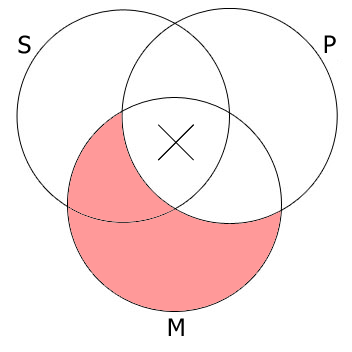
Here are the four categorical propositions illustrated with Venn Diagrams:


III. Categorical Syllogisms
Combining categorical propositions, we create categorical syllogisms. A categorical syllogism is a syllogistic argument consisting of three categorical propositions (two premises and a conclusion) and three categorical terms, each of which is used twice.

There are a total of 256 possible varieties of categorical syllogisms but only 15 are valid (per Boolean logic). Two important valid categorical syllogisms are:

BARBARA, AAA-1
1. All M are P
2. All S are M
3. Therefore all S are P


DARII, AII-1
1. All M are P
2. Some S are M
3. Therefore some S are P


Here is a link to a page which lists all 15 valid categorical syllogisms along with their corresponding Venn diagrams.

The validity of a categorical syllogism can be determined by either applying a set of rules or through the use of Venn diagrams. Here are two links which expand on the subject"
-The six necessary conditions for valid categorical syllogisms
-Testing validity using Venn diagrams


Santa Barbara City College: Philosophy-111 Critical Thinking And Writing: The 15 Valid Syllogistic Forms

Society for Positive Philosophy and Interdisciplinary Studies (SPPIS): A Classroom Introduction to Logic: Nature of Proposition

Tuesday, November 4, 2014

FCKH8's Insane New Video

I recently watched the controversial (and by that I mean vile) video by T-shirt/activist company FCKH8. It features little girls dressed as princesses angrily shouting about how women are mistreated and abused by our patriarchal society. It does it's best to shock the viewer by making sure the little darlings say the word fuck as often as possible. If you are easily traumatized by offensive language, here is a link to a bleeped version, but I suggest you watch the actual video below to get the full effect.


Even if you agree with its message and accept its controversial statistics (more here and here), there is still plenty to hate this video for. It's implied message is that people who may be offended or critical of the little girls' indignant swearing really have no right to feel that way because of the much bigger gender problems it seeks to address. This type of rationalization seems to me to be a form of the fallacy of relative privation or what is sometimes referred to as the not as bad fallacy. The form of the argument goes something like:

B happened, and is worse then A.
Therefore A is justified.

The obvious problem with this sort of thinking is that the existence of the worse thing does nothing to change the fact that the less bad thing is still bad. Hence the existence of gender inequality or abuse toward women does nothing to change the fact that little girls shouldn't swear and T-Shirt companies shouldn't make vulgar videos which exploit children to push their ideology. I mean any moron should be able to see how completely inappropriate it is to force these young children (the youngest of which was 6) to confront serious adult issues such as rape. I can only hope the backlash FCKH8 receives is enough to keep them from producing future repulsive videos.


Monday, October 27, 2014

The Paradise Ghost Town of Varosha


Beautiful sandy beaches adjoin dilapidated high rise hotels making Varosha one of the more intriguing ghost towns. To understand why it was abandoned we have to start with a quick history lesson.

Varosha is a section of the city of Famagusta on the east coast of Northern Cyprus. Cyprus is a Mediterranean island whose population consists of two ethnic communities: Greek and Turkish. The island was under the control of the Ottoman empire from 1571 to 1878 and then under British control from 1878 to 1960.  During British rule there was a growing nationalist movement by the majority Greek Cypriots for union with Greece (enosis). The British opposed the enosis movement which lead to numerous protest, riots and acts of violence. In the late 1950's, Turkish Cypriots responded to the enosis demand by calling for partition (taksim) of the island. In an attempt to deal with increased violence between the two ethnic groups, the London and Zurich Agreements resulted in Cyprus gaining its independence from Britain in 1960. Almost immediately the new government began to fall apart as cooperation between the two sides could not be achieved.

In 1974 there was a coup d'état of the government by the Cypriot National Guard assisted by the military junta which at that time ruled Greece. Then President Makarios III was replaced with a pro-Enosis nationalist dictator named Nikos Sampson. In response to the coup, Turkey invaded the island, taking control of the north. Just hours before the Turkish and Greek Cypriot armies met in Varosha, the entire population fled. Once Turkish forces gained control of the area, it was fenced off and became part of of the Green Line, which is the present day border between the two communities.

To this day the area remains barricaded and patrolled by the Turkish military. Though most items of value were stolen long ago by Turkish soldiers and other marauders, the majority of the areas buildings still exist in various states of decay.


Here are images of Varosha before the 1974 invasion.


Update: This 2018 video shows that the empty city is vastly larger than the beach front property typically shown.

Thursday, October 16, 2014

Sci-Fi Short: Yardbird


A really solid sci-fi/paranormal short film from Australian director Michael Spiccia.  Though it doesn't have the most unique story line (with obvious parallels to the classic horror film Carrie), Yardbird is a really put together short with solid acting and beautiful cinematography.


Yardbird from Bridle Path Films on Vimeo.

Monday, October 13, 2014

Straw Man Fallacy

A straw man argument is an informal fallacy of relevance where an arguer distorts or misrepresents his or her opponent's position in order to more easily refute it. The obvious fallacy with this sort of argument is that the weaker, misrepresented position which is being refuted (the straw man) is not the actual claim being made.

Though the etymology of the term is unclear, a commonly stated origin is that it comes from the past use of straw man dummies by the military to train soldiers. Though the dummy represents the enemy it is of course a far easier opponent to defeat than a real person.

The straw man argument has the following form:

Person A has position X.
Person B presents position Y (which is a distortion or misrepresentation of position X).
Person B then attacks position Y (the so called straw man).
Therefore position X is false.

Example:
Bob says "It would be a good idea to ban advertising beer and wine on radio and television. These ads encourage teenagers to drink, often with disastrous consequences."

John replies "You cannot get people to give up drinking: they've been doing it for thousands of years."

Bob did not propose that people give up drinking yet John misrepresents it as such providing him with an easier argument to refute.

Methods of Argumentation
The Nizkor Project: Fallacy: Straw Man