Occasionally I like to take the time to look into stories that I find a little bit fishy. I do it as a sort of exercise which usually lends credence to the old saying "Don't believe everything you read."
I got into this one after reading a post a friend made on Facebook which linked to a story on The Free Thought Project titled Texas Town Experiences 61% Drop in Crime After Firing Their Police Department. The article essentially says that in 2012, the city of Sharpstown "fired their cops" and "hired S.E.A.L. Security Solutions, a private firm, to patrol their streets." A representative of the security firm is quoted saying "Since we've been in there, an independent crime study that they've had done [indicates] we've reduced the crime by 61%” in just 20 months.
After looking into it a bit I found similar stories had been released within the last couple of days such as Texas City Gets Rid of Police Dept., Hires ‘SEAL Security’ — Guess What Reportedly Happened to Crime from the Blaze, Texas Town Fires Entire Police Department, Crime Drops by 61%, from Infowars and Texas town sees crime drop by almost two thirds after firing police, hiring private security from Rare. As the titles suggest, these stories all either directly state or indirectly imply that the city of Sharpstown fired their police department and hired a private security firm to take its place. But is this actually what happened? In a word, no.
According to Wikipedia, Sharpstown is a master-planned community in Greater Sharpstown, Southwest Houston, Texas which is served by two Houston Police Department patrol divisions. For many years, the Sharpstown Civic Association had contracted with Harris County Constables for additional patrols but due to budgetary issues ended the relationship in 2012. It is this arrangement for additional patrols that the above articles are referring to when they state that the city fired their police department.
I'm not sure if this is a matter of shoddy journalism or a deliberate act to fabricate a story which would be more appealing to their readers? As it took very little effort for me to discover the truth, I'm inclined to think it's the latter. The sad thing is, there was a perfectly good story here which didn't need to be based on the false claim that the town fired their police department. It could have been titled something like, City of Sharpstown turns to private security to help patrol its streets. The article could then talk about how the constables used to be contracted to patrol the area but that the security firm does the job at half the cost and with better results. See, no need for the lies and false implications.
NEIGHBORS WORRIED AFTER CRIME SPIKE IN SHARPSTOWN
Popular Constables On Patrol Program (COPS) Discontinued
Thursday, March 5, 2015

Friday, February 6, 2015
Propositional Logic / Sentential Logic
I. Introduction
Propositional logic (also called propositional calculus, sentential calculus, sentential logic, etc.) is a branch of logic that studies ways of joining simple (atomic) propositions to form more complicated propositions using logical connectives, and the logical relationships of these propositions.
To highlight the difference between term and propositional logic, think of the sentence "All dogs are mammals". Using term logic we would say the fundamental units of the sentence are the categories of dogs and mammals. In contrast, with propositional logic the fundamental unit of the sentence is the entire statement or proposition "All dogs are mammals". It's important not to equate propositions with sentences as a sentence can have more than one statement. For instance, the sentence “All dogs are mammals, and all cats are mammals too” clearly contains the two propositions.
II. Propositions
A proposition can be defined as a declarative sentence, or part of a sentence, that is capable of having a truth-value of either true or false, but not both. For the purpose of this post, the term "proposition" and "statement" are used interchangeably.
For example, "Paris is the capital of France." is a proposition with a truth value of "true" while the sentence, "Everyone born on Monday has purple hair" has a truth value of "false."
Some sentences are not propositions such as commands like "Close the door" or questions like "Is it hot outside?"
The smallest indivisible units in propositional logic are statements referred to as simple or atomic propositions. These are statements which are either true or false and cannot be broken down into other simpler statements. For example, "The dog ran" is an atomic proposition. Atomic propositions can be used to form complex propositions by using connective words (see connectives below). For example, "the dog ran and the cat hid" is a complicated proposition which combines two atomic propositions using the connective word "and".
III. The Language of Propositional Logic
Classical truth-function propositional logic utilizes a simple symbolic language to represent propositions expressed in natural language such as English. Simple (atomic) statements are represented by capital letters 'A', 'B', 'C', etc. The logical signs '∧', '∨', '→', '↔', and '~' are used in place of the truth-functional operators, "and", "or", "if... then...", "if and only if", and "not", respectively. Parentheses are used to group propositions similar to how they are used in algebra and arithmetic.
A. Connectives (logical operators)
Connectives (logical operators) are words or phrases used either to modify a statement or join simple statements together to form a complex statement. Though there are many connectives, the five basic ones are:
NOT, AND, OR, IF_THEN (or IMPLY), IF AND ONLY IF.
Here is a chart of which shows the logical operator (connectives formal name), the symbol and its natural language usage.
Not-P. For example, “It is not green.”
The negation of statement P, simply written "~P" in language PL, is regarded as true if P is false, and false if P is true. Unlike the other operators, negation is applied to a single statement. The corresponding chart can therefore be drawn more simply as follows:

Though the word "not" is generally thought of as the English equivalent of "~", it can be expressed in many ways such as:
It is not the case that...
It would be false to say that...
...failed to...
2. Conjunction
p and q. For example, “It is wet and it is cold.”
Conjunction is a truth-functional connective similar to "and" in English and written "∧" in PL. When dealing with a conjunction, you must consider both p and q. That is, a conjunction is true if and only if both conjuncts are true.

Though "and" is generally thought as the English equivalent to "∧" there are many ways it can be expressed. Some include:
both...and...
...as well as...
...but...
...however...
...though...
...nevertheless...
...still...
...while...
...despite the fact that...
Though these may not seem similar to the word "and" it is important to remember that propositional logic treats as a conjunction any sentence whose truthfulness depends on both conjuncts being true and false if any or both conjuncts are false. For instance, the sentence "John loves Mary even though she barely tolerates him" is true only if both propositions "John loves Mary" and "She barely tolerates him" are true. If either or both are false, the whole proposition is false.
3. Disjunction
p or q (or both). For example, “It is wet or it is cold.”
Disjunction is a truth-functional connective similar to "or" in English. The disjunction of two statements p and q, written in PL as "(p ∨ q)", is true if either p is true or q is true, or both p and q are true, and is false only if both p and q are false.
Though we say that "or" is the rough English equivalent to PL "∨", it should be noted that "∨" is used in the inclusive sense. More often than not when the word "or" is used to join together two English statements, we only regard the whole as true if one side or the other is true, but not both, as with the statement "Either we can buy the toy robot, or we can buy the toy truck; you must choose!" This is called the exclusive sense of "or". However, in PL, the sign "v" is used inclusively such as with the statement "Her grades are so good that she's either very bright or studies hard" which does not exclude the possibility of both.

Though the word "or" is generally used (imperfectly) as the English equivalent to "∨", there are other ways it can be expressed such as:
either...or...
...and/or...
4. Conditional (material implication)
If p, then q. For example, “If it is green, then it is heavy.”
The conditional is a connective similar to "if_then_" statements in English and generally represented as "→" in PL. The first simple statement in a conditional is referred to as antecedent and the second simple statement is known as the consequent. For example, with the statement "If you flip the light switch, the lights will go out" the antecedent is "You flip the light switch" and the consequent is "the lights will go out".
A conditional statement asserts that if the antecedent p is true, the consequent q will be true as well. In other words, a conditional statement is only false if the antecedent p is true and the consequent q is false.

5. Biconditional (material equivalence)
p if and only if q. For example "A triangle is equilateral if and only if it is a triangle with three equal sides".
The biconditional is a connective similar to "if and only if" statements in English and generally represented as "↔" in PL. A biconditional is regarded as true if the antecedent and consequent are either both true or both false, and is regarded as false if either have different truth-values.

B. Scope, Parentheses and the Main Connective
Whenever more than one connective is used in a statement, there is a chance of ambiguity. Consider the statement S∨C∧T where S is "I will show you stamps", C is "I will make you some coffee" and T is "I will give you $1000". Hence, in English it would be written, "I will show you my stamps or make you coffee and give you $1000".
As it is presented, the statement is ambiguous and could be interpreted in two different ways:
1) "I will show you my stamps or make you coffee but in any event, I will give you $1000".
2) "Either I will show you my stamps or make you coffee and give you $1000".
The problem here is that we don't know what the scope is of either of the two connectives used in the statement. Does the disjunction in S∨C∧T connect S to C or does it connect S to C∧T? Does the conjunction in S∨C∧T connect C to T or does it connect S∨C to T?
To deal with this problem, parentheses are used to establish scope. So going back to our two interpretations of S∨C∧T, we would write:
1) "I will show you my stamps or make you coffee but in any event, I will give you $1000" as ((S∨C)∧T).
2) "Either I will show you my stamps or make you coffee and give you $1000" as (S∨(C∧T)).
*Note that in actual practice you will often find the outermost parentheses are omitted.
In propositional logic, the main connective is the connective with the greatest scope in a statement. For example, with ((S∨C)∧T) we see that the scope of ∨ is limited to S and C while the scope of ∧ encompasses the entire statement. Therefore, in this example ∧ is the main operator.
Internet Encyclopedia of Philosophy: Propositional Logic
Introduction to Logic (second edition): Harry Gensler
Critical Thinking: An Appeal to Reason by Peg Tittle: Supplemental Chapter: Propositional Logic
Wikipedia: Negation
Wikipedia: Logical conjunction
Wikipedia: Logical disjunction
Logic Self-Taught: A Workbook
https://proofwiki.org/wiki/Definition:Scope_(Logic)
http://www.bu.edu/linguistics/UG/course/lx502/_docs/lx502-propositional%20logic.pdf
Propositional logic (also called propositional calculus, sentential calculus, sentential logic, etc.) is a branch of logic that studies ways of joining simple (atomic) propositions to form more complicated propositions using logical connectives, and the logical relationships of these propositions.
To highlight the difference between term and propositional logic, think of the sentence "All dogs are mammals". Using term logic we would say the fundamental units of the sentence are the categories of dogs and mammals. In contrast, with propositional logic the fundamental unit of the sentence is the entire statement or proposition "All dogs are mammals". It's important not to equate propositions with sentences as a sentence can have more than one statement. For instance, the sentence “All dogs are mammals, and all cats are mammals too” clearly contains the two propositions.
II. Propositions
A proposition can be defined as a declarative sentence, or part of a sentence, that is capable of having a truth-value of either true or false, but not both. For the purpose of this post, the term "proposition" and "statement" are used interchangeably.
For example, "Paris is the capital of France." is a proposition with a truth value of "true" while the sentence, "Everyone born on Monday has purple hair" has a truth value of "false."
Some sentences are not propositions such as commands like "Close the door" or questions like "Is it hot outside?"
The smallest indivisible units in propositional logic are statements referred to as simple or atomic propositions. These are statements which are either true or false and cannot be broken down into other simpler statements. For example, "The dog ran" is an atomic proposition. Atomic propositions can be used to form complex propositions by using connective words (see connectives below). For example, "the dog ran and the cat hid" is a complicated proposition which combines two atomic propositions using the connective word "and".
III. The Language of Propositional Logic
Classical truth-function propositional logic utilizes a simple symbolic language to represent propositions expressed in natural language such as English. Simple (atomic) statements are represented by capital letters 'A', 'B', 'C', etc. The logical signs '∧', '∨', '→', '↔', and '~' are used in place of the truth-functional operators, "and", "or", "if... then...", "if and only if", and "not", respectively. Parentheses are used to group propositions similar to how they are used in algebra and arithmetic.
A. Connectives (logical operators)
Connectives (logical operators) are words or phrases used either to modify a statement or join simple statements together to form a complex statement. Though there are many connectives, the five basic ones are:
NOT, AND, OR, IF_THEN (or IMPLY), IF AND ONLY IF.
Here is a chart of which shows the logical operator (connectives formal name), the symbol and its natural language usage.
 |
| As there are no absolute standards in regards to symbols used in Propositional Logicdifferent authors use different symbols. This link provides a list of alternate symbols you may come across. |
1. NegationNot-P. For example, “It is not green.”
The negation of statement P, simply written "~P" in language PL, is regarded as true if P is false, and false if P is true. Unlike the other operators, negation is applied to a single statement. The corresponding chart can therefore be drawn more simply as follows:

Though the word "not" is generally thought of as the English equivalent of "~", it can be expressed in many ways such as:
It is not the case that...
It would be false to say that...
...failed to...
2. Conjunction
p and q. For example, “It is wet and it is cold.”
Conjunction is a truth-functional connective similar to "and" in English and written "∧" in PL. When dealing with a conjunction, you must consider both p and q. That is, a conjunction is true if and only if both conjuncts are true.

Though "and" is generally thought as the English equivalent to "∧" there are many ways it can be expressed. Some include:
both...and...
...as well as...
...but...
...however...
...though...
...nevertheless...
...still...
...while...
...despite the fact that...
Though these may not seem similar to the word "and" it is important to remember that propositional logic treats as a conjunction any sentence whose truthfulness depends on both conjuncts being true and false if any or both conjuncts are false. For instance, the sentence "John loves Mary even though she barely tolerates him" is true only if both propositions "John loves Mary" and "She barely tolerates him" are true. If either or both are false, the whole proposition is false.
3. Disjunction
p or q (or both). For example, “It is wet or it is cold.”
Disjunction is a truth-functional connective similar to "or" in English. The disjunction of two statements p and q, written in PL as "(p ∨ q)", is true if either p is true or q is true, or both p and q are true, and is false only if both p and q are false.
Though we say that "or" is the rough English equivalent to PL "∨", it should be noted that "∨" is used in the inclusive sense. More often than not when the word "or" is used to join together two English statements, we only regard the whole as true if one side or the other is true, but not both, as with the statement "Either we can buy the toy robot, or we can buy the toy truck; you must choose!" This is called the exclusive sense of "or". However, in PL, the sign "v" is used inclusively such as with the statement "Her grades are so good that she's either very bright or studies hard" which does not exclude the possibility of both.

Though the word "or" is generally used (imperfectly) as the English equivalent to "∨", there are other ways it can be expressed such as:
either...or...
...and/or...
4. Conditional (material implication)
If p, then q. For example, “If it is green, then it is heavy.”
The conditional is a connective similar to "if_then_" statements in English and generally represented as "→" in PL. The first simple statement in a conditional is referred to as antecedent and the second simple statement is known as the consequent. For example, with the statement "If you flip the light switch, the lights will go out" the antecedent is "You flip the light switch" and the consequent is "the lights will go out".
A conditional statement asserts that if the antecedent p is true, the consequent q will be true as well. In other words, a conditional statement is only false if the antecedent p is true and the consequent q is false.

5. Biconditional (material equivalence)
p if and only if q. For example "A triangle is equilateral if and only if it is a triangle with three equal sides".
The biconditional is a connective similar to "if and only if" statements in English and generally represented as "↔" in PL. A biconditional is regarded as true if the antecedent and consequent are either both true or both false, and is regarded as false if either have different truth-values.

B. Scope, Parentheses and the Main Connective
Whenever more than one connective is used in a statement, there is a chance of ambiguity. Consider the statement S∨C∧T where S is "I will show you stamps", C is "I will make you some coffee" and T is "I will give you $1000". Hence, in English it would be written, "I will show you my stamps or make you coffee and give you $1000".
As it is presented, the statement is ambiguous and could be interpreted in two different ways:
1) "I will show you my stamps or make you coffee but in any event, I will give you $1000".
2) "Either I will show you my stamps or make you coffee and give you $1000".
The problem here is that we don't know what the scope is of either of the two connectives used in the statement. Does the disjunction in S∨C∧T connect S to C or does it connect S to C∧T? Does the conjunction in S∨C∧T connect C to T or does it connect S∨C to T?
To deal with this problem, parentheses are used to establish scope. So going back to our two interpretations of S∨C∧T, we would write:
1) "I will show you my stamps or make you coffee but in any event, I will give you $1000" as ((S∨C)∧T).
2) "Either I will show you my stamps or make you coffee and give you $1000" as (S∨(C∧T)).
*Note that in actual practice you will often find the outermost parentheses are omitted.
In propositional logic, the main connective is the connective with the greatest scope in a statement. For example, with ((S∨C)∧T) we see that the scope of ∨ is limited to S and C while the scope of ∧ encompasses the entire statement. Therefore, in this example ∧ is the main operator.
Internet Encyclopedia of Philosophy: Propositional Logic
Introduction to Logic (second edition): Harry Gensler
Critical Thinking: An Appeal to Reason by Peg Tittle: Supplemental Chapter: Propositional Logic
Wikipedia: Negation
Wikipedia: Logical conjunction
Wikipedia: Logical disjunction
Logic Self-Taught: A Workbook
https://proofwiki.org/wiki/Definition:Scope_(Logic)
http://www.bu.edu/linguistics/UG/course/lx502/_docs/lx502-propositional%20logic.pdf
Tuesday, January 13, 2015
Waw An-Namus: Libya

Waw An-Namus is an extinct volcano located in the Sahara desert of south-central Libya. It's caldera is 4 km wide and 100 m deep with a central cone surrounded by three small salt lakes. Surrounding the caldera is 20 km of dark-black deposits of ash which causes Waw An-Namus to starkly standout against the light yellow sand of the Sahara.
 |
| Image of Waw an Namus taken from the International Space Station |


Over the past couple of decades, Waw An-Namus has become a somewhat popular tourist attraction for travelers visiting this part of the Sahara. Unfortunately, this has led to negative impacts on the landscape as well as the rare plant and animal life. Tour guides often drive there vehicles down the caldera so the tourist can picnic by the lakes. A few years ago, some careless visitors caused a fire burning a large area of reeds and date palms.

Libya Herald: Waw An-Namus: A prehistoric volcano and natural heritage attraction
Viralnova: There's Something Very Different About This Crater In The Desert. When You Go Inside... WOW.
Monday, December 29, 2014
Thinking Skills
Thinking Skills (Average Joe Edition/Addition)
The following is an attempt to organize my posts related to clear thinking, problem solving and decision making into a coherent, easy to use format. As the title suggests, I'm just an average guy trying to get a better understanding of these topics and as such, have no doubt oversimplified or misunderstood some of these concepts. Perhaps they may be of some benefit to someone out there but please do your own research.
I. Fundamentals of Informal Logic
A. Informal Logic in a Nutshell: Argument & Argument Analysis
B. Deductive Arguments
1) Categorical Logic
2) Propositional Logic
C. Inductive Arguments
1) Inductive Generalization
2) Statistical Syllogism
3) Analogical Arguments
4) Causal Arguments
a. Mill's Methods
b. Bradford Hill criteria
D. Abductive Arguments
E. Logical Fallacies
-Ad Hominem
-Appeal to Authority
-Appeal to Popularity
-Argument from Ignorance
-Begging the Question/Circular Reasoning
-Equivocation
-False Analogy
-False Dichotomy
-Guilt by Association
-Hasty Generalization
-Non-Sequitur
-Post Hoc Ergo Propter Hoc
-Red Herring
-Tu Quoque
-Straw Man
II. Cognitive Psychology
A. Dual Process Model of Thinking
B. Cognitive Bias
-Confirmation Bias and Positive Test Strategy
-Dunning-Kruger Effect
-Framing Effect
-Gambler's Fallacy
The following is an attempt to organize my posts related to clear thinking, problem solving and decision making into a coherent, easy to use format. As the title suggests, I'm just an average guy trying to get a better understanding of these topics and as such, have no doubt oversimplified or misunderstood some of these concepts. Perhaps they may be of some benefit to someone out there but please do your own research.
I. Fundamentals of Informal Logic
A. Informal Logic in a Nutshell: Argument & Argument Analysis
B. Deductive Arguments
1) Categorical Logic
2) Propositional Logic
C. Inductive Arguments
1) Inductive Generalization
2) Statistical Syllogism
3) Analogical Arguments
4) Causal Arguments
a. Mill's Methods
b. Bradford Hill criteria
D. Abductive Arguments
E. Logical Fallacies
-Ad Hominem
-Appeal to Authority
-Appeal to Popularity
-Argument from Ignorance
-Begging the Question/Circular Reasoning
-Equivocation
-False Analogy
-False Dichotomy
-Guilt by Association
-Hasty Generalization
-Non-Sequitur
-Post Hoc Ergo Propter Hoc
-Red Herring
-Tu Quoque
-Straw Man
A. Dual Process Model of Thinking
B. Cognitive Bias
-Confirmation Bias and Positive Test Strategy
-Dunning-Kruger Effect
-Framing Effect
-Gambler's Fallacy
Sunday, December 21, 2014
Name a Star... and lose $54 bucks
Over the last few weeks, during my drive to work, I've been hearing those commercials on the radio where, for $54 dollars you can name a star after someone. Yep, that's right. For the low price of $54 dollars, the very official sounding International Star Registry will provide you with a beautiful, full color parchment certificate personalized with the star's name, date and coordinates along with a detailed star chart showing your star circled in red.
The commercial goes on to say that since 1979 the International Star Registry has named countless stars for celebrities, dignitaries, royalty and Joe Schmoes just like you. The star name is recorded in the Astronomical Catalog which will be registered with the U.S. copyright office.
With Christmas right around the corner, you might be thinking this would be the perfect gift. In this ephemeral world that we live, who wouldn't want something which would provide a sense of permanency. A star in our name, something that would be there long after we are gone. A small reference to our existence, immortalized for future generations to see.
Yes, it would indeed be the perfect gift, if it wasn't largely a scam.
Though the International Star Registry sounds very official, in reality they are not recognized or used by any scientific institutions. They are a private, for profit company which is simply finding a star, labeling it with the purchased name and recording it in their catalog. That's it. The catalog is simply a company database. It is not used by the scientific community. In reality, it seems the International Astronomical Union (IAU) "is the internationally recognized authority for naming celestial bodies and surface features on them. And names are not sold, but assigned according to internationally accepted rules."
It should be noted that there is nothing illegal with what International Star Registry is doing. When I said earlier that it was a scam, I didn't mean that the company was breaking the law, only that what they are doing is deceptive. And while it may seem like a largely harmless deception, there are people that experience a heavy emotional disappointment when learning the truth. As Stuart Atkinson wrote on his blog Cumbrian Sky "I feel very strongly about, I don’t mind admitting. Why? Because I am tired of having to disappoint and upset people who come to me as star parties and astronomy meetings, asking me if I can help find the star they “named” after their deceased mother, father, son, daughter, brother, sister, fiance, wife, husband, grandmother, grandfather or pet. These people “buy” stars in good faith, thinking, genuinely, that a way out of – or to at least ease – their grief is to buy a star for their dead loved one, thus immortalising them and preserving their memory. They are led to believe by the advertising blurb that “their star ” will be on view in the sky for all to see… so they come up to me at a star party, ask me to point out the star they bought, or, if it’s cloudy, point it out to them on a star chart or in an atlas. And I feel sick to my stomach when I have to tell them that the star they “bought” and “named” only bears that name in that company’s star registry database, and that you need a telescope to see it."
So save yourself $54 dollars and get a present your loved one will really enjoy. Or, if you are still not dissuaded, send me the money and I'll provide a star for you to name. I'll write it down in a book and keep it safe for you. After all, it isn't much less than what the star naming companies do.
Sunday, December 14, 2014

Saturday, December 6, 2014
Categorical Syllogisms
Term Logic / Syllogistic Logic / Aristotelian Logic
Originating with Aristotle, term logic was the dominant form of logic used till the the late nineteenth century. It reasons on the basis of the relationships between categories (referred to as terms).
I. Categorical Terms
Originating with Aristotle, term logic was the dominant form of logic used till the the late nineteenth century. It reasons on the basis of the relationships between categories (referred to as terms).
I. Categorical Terms
The basic unit in categorical syllogistic logic is the categorical term. Categorical terms are simply the placing of things or concepts into distinct classes or categories based on some specified characteristics. Each categorical term divides the world into those things included in the category and those things not included.
II. Categorical Propositions
With categorical terms we can build categorical propositions. A Categorical propositions is a statement with two categorical terms which asserts some relationship between them.
There are four parts to a categorical proposition. In standard form, the first term in the statement is referred to as the subject term (the term which we are saying something about) and the second as the predicate term. The relationship between the subject and predicate terms is described through the use of a copula and quantifier. The copula (also referred to as quality) denotes either an affirmative/inclusive relationship (are) or negative/exclusive (are not) relationship. The quantifier provides how much of the subject term relates to the predicate term by use of universal quantifiers (all, none), and particular quantifiers (some).
A model categorical proposition can be represented as:
Quantifier [subject term] copula [predicate term]
So with the example All men are mortal; the word All is the quantifier, men is the subject term, are is the copula and mortal is the predicate term.
There are four types of categorical propositions:
A: Universal Affirmative
All S are P
E: Universal Negative
No S are P
I: Particular Affirmative
Some S are P
O: Particular Negative
Some S are not P
Here are the four categorical propositions illustrated with Venn Diagrams:
III. Categorical Syllogisms
Combining categorical propositions, we create categorical syllogisms. A categorical syllogism is a syllogistic argument consisting of three categorical propositions (two premises and a conclusion) and three categorical terms, each of which is used twice.
There are a total of 256 possible varieties of categorical syllogisms but only 15 are valid (per Boolean logic). Two important valid categorical syllogisms are:
BARBARA, AAA-1
1. All M are P
2. All S are M
3. Therefore all S are P

DARII, AII-1
1. All M are P
Here is a link to a page which lists all 15 valid categorical syllogisms along with their corresponding Venn diagrams.
The validity of a categorical syllogism can be determined by either applying a set of rules or through the use of Venn diagrams. Here are two links which expand on the subject"
-The six necessary conditions for valid categorical syllogisms
-Testing validity using Venn diagrams
Santa Barbara City College: Philosophy-111 Critical Thinking And Writing: The 15 Valid Syllogistic Forms
Society for Positive Philosophy and Interdisciplinary Studies (SPPIS): A Classroom Introduction to Logic: Nature of Proposition
II. Categorical Propositions
With categorical terms we can build categorical propositions. A Categorical propositions is a statement with two categorical terms which asserts some relationship between them.
There are four parts to a categorical proposition. In standard form, the first term in the statement is referred to as the subject term (the term which we are saying something about) and the second as the predicate term. The relationship between the subject and predicate terms is described through the use of a copula and quantifier. The copula (also referred to as quality) denotes either an affirmative/inclusive relationship (are) or negative/exclusive (are not) relationship. The quantifier provides how much of the subject term relates to the predicate term by use of universal quantifiers (all, none), and particular quantifiers (some).
A model categorical proposition can be represented as:
Quantifier [subject term] copula [predicate term]
So with the example All men are mortal; the word All is the quantifier, men is the subject term, are is the copula and mortal is the predicate term.
There are four types of categorical propositions:
A: Universal Affirmative
All S are P
E: Universal Negative
No S are P
I: Particular Affirmative
Some S are P
O: Particular Negative
Some S are not P
Here are the four categorical propositions illustrated with Venn Diagrams:
 |
III. Categorical Syllogisms
Combining categorical propositions, we create categorical syllogisms. A categorical syllogism is a syllogistic argument consisting of three categorical propositions (two premises and a conclusion) and three categorical terms, each of which is used twice.
There are a total of 256 possible varieties of categorical syllogisms but only 15 are valid (per Boolean logic). Two important valid categorical syllogisms are:
BARBARA, AAA-1
1. All M are P
2. All S are M
3. Therefore all S are P
DARII, AII-1
1. All M are P
2. Some S are M
3. Therefore some S are P
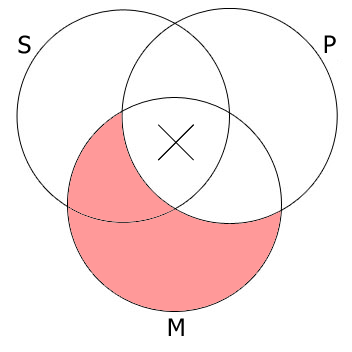
3. Therefore some S are P
Here is a link to a page which lists all 15 valid categorical syllogisms along with their corresponding Venn diagrams.
The validity of a categorical syllogism can be determined by either applying a set of rules or through the use of Venn diagrams. Here are two links which expand on the subject"
-The six necessary conditions for valid categorical syllogisms
-Testing validity using Venn diagrams
Santa Barbara City College: Philosophy-111 Critical Thinking And Writing: The 15 Valid Syllogistic Forms
Society for Positive Philosophy and Interdisciplinary Studies (SPPIS): A Classroom Introduction to Logic: Nature of Proposition
Tuesday, November 4, 2014
FCKH8's Insane New Video
I recently watched the controversial (and by that I mean vile) video by T-shirt/activist company FCKH8. It features little girls dressed as princesses angrily shouting about how women are mistreated and abused by our patriarchal society. It does it's best to shock the viewer by making sure the little darlings say the word fuck as often as possible. If you are easily traumatized by offensive language, here is a link to a bleeped version, but I suggest you watch the actual video below to get the full effect.
Even if you agree with its message and accept its controversial statistics (more here and here), there is still plenty to hate this video for. It's implied message is that people who may be offended or critical of the little girls' indignant swearing really have no right to feel that way because of the much bigger gender problems it seeks to address. This type of rationalization seems to me to be a form of the fallacy of relative privation or what is sometimes referred to as the not as bad fallacy. The form of the argument goes something like:
B happened, and is worse then A.
Therefore A is justified.
The obvious problem with this sort of thinking is that the existence of the worse thing does nothing to change the fact that the less bad thing is still bad. Hence the existence of gender inequality or abuse toward women does nothing to change the fact that little girls shouldn't swear and T-Shirt companies shouldn't make vulgar videos which exploit children to push their ideology. I mean any moron should be able to see how completely inappropriate it is to force these young children (the youngest of which was 6) to confront serious adult issues such as rape. I can only hope the backlash FCKH8 receives is enough to keep them from producing future repulsive videos.
Subscribe to:
Posts (Atom)